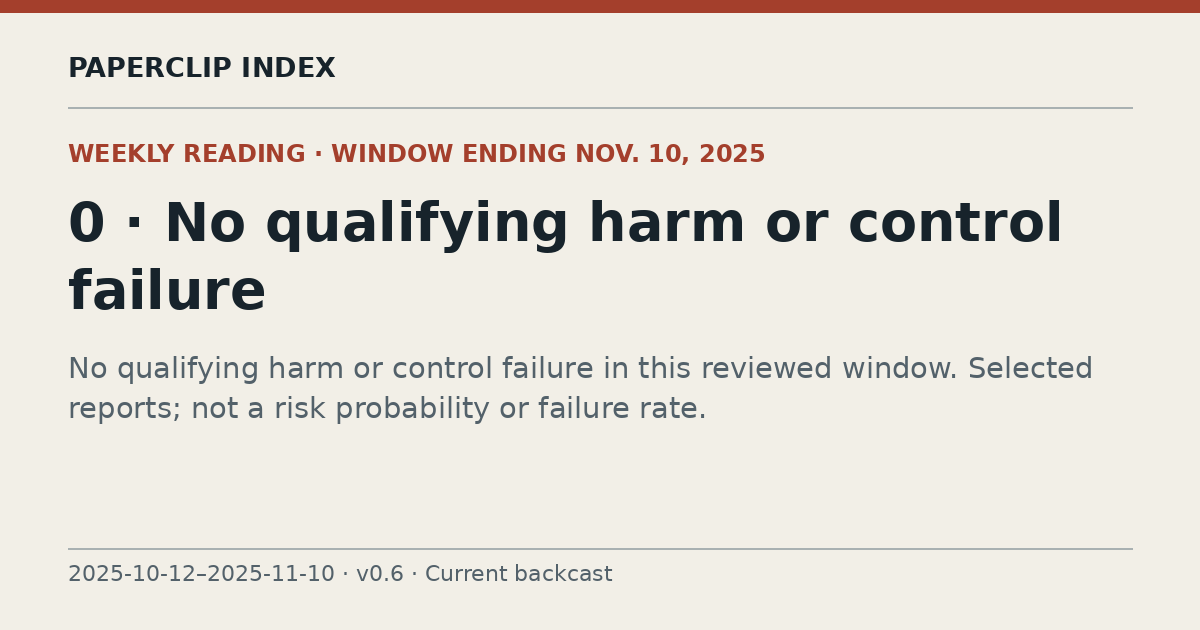
Weekly reading · methodology v0.6
Window ending Nov. 10, 2025
Harms count in full for two weeks after they are reported, then one level less every two weeks. The control floor looks at reports from Oct. 12, 2025 through Nov. 10, 2025. A selected catalogue of reported AI incidents, reviewed through Oct. 7, 2026. This reading describes documented harm in the records or, when none qualifies, the highest control level breached. It is not a forecast or a measure of all AI activity.
Current recalculation
0
No qualifying harm or control failure · No qualifying harm or control failure in this reviewed window.
Recalculated from the catalogue in this build. Historical backcasts were not published at the time.
Published at the time
No publication snapshot exists for this week.
This is a backcast from the current catalogue. It was not a reading published at the time.
Records behind this reading
1 selected record; 0 documented external harms counting (0 qualifying). Records and ratings below reflect the current catalogue.
0 qualifying harm records.
- Documented harm
- 0
- No harm found (stated scope)
- 0
- No harm reported
- 0
- Impact unknown
- 0
- Alleged, AI role uncorroborated
- 1
- Counts toward the index
- 0
- Unverified, watching
- 0
- Alleged in court
- 1
- Control failure, tracked
- 0
- Tracked separately
- 0
Documented exclusions: 0 internal; 0 awaiting evidence review. 0 qualifying records with a bounded single-source review.
Inspect the evidence · 1 record
- PI-0032 · Seven lawsuits allege ChatGPT (GPT-4o) contributed to four suicides and to serious delusionsAlleged, AI role uncorroborated · excluded from the harm reading
Status totals cover counted records; aliases, superseded aggregates and records tracked separately are excluded. Eligibility and extent notes overlap those totals. These observations are not statistical uncertainty bounds.
- PI-0032Seven lawsuits allege ChatGPT (GPT-4o) contributed to four suicides and to serious delusionsNov. 6, 2025 · Severe harm, alleged · Deployment
Sources
These links support the records above. Source availability and conclusions may change.
- Tech Justice Law Project: Tech Justice Law Project and Social Media Victims Law Center lawsuits accuse ChatGPT of emotional manipulation, supercharging AI delusions, and acting as a suicide coachCited in PI-0032
- Tech Justice Law Project: Seven 'AI Delusional Disorder' Cases: Shamblin, Irwin, Fox, Enneking, Madden, Brooks, and Lacey v. OpenAI et al.Cited in PI-0032
- Superior Court of California, San Francisco (copy hosted by Reason): ChatGPT Product Liability Cases, JCCP 5431: Order re Petition for CoordinationCited in PI-0032
- Deseret News: OpenAI faces seven lawsuits over suicide deaths tied to ChatGPTCited in PI-0032
- KQED: OpenAI Faces Legal Storm Over Claims Its AI Drove Users to Suicide, DelusionsCited in PI-0032
- WLOS / The National News Desk (Sinclair): New lawsuits accuse OpenAI's ChatGPT of 'acting as a suicide coach'Cited in PI-0032
All weekly readings · How this reading is calculated · Download the weekly card