Weekly reading · methodology v1.1
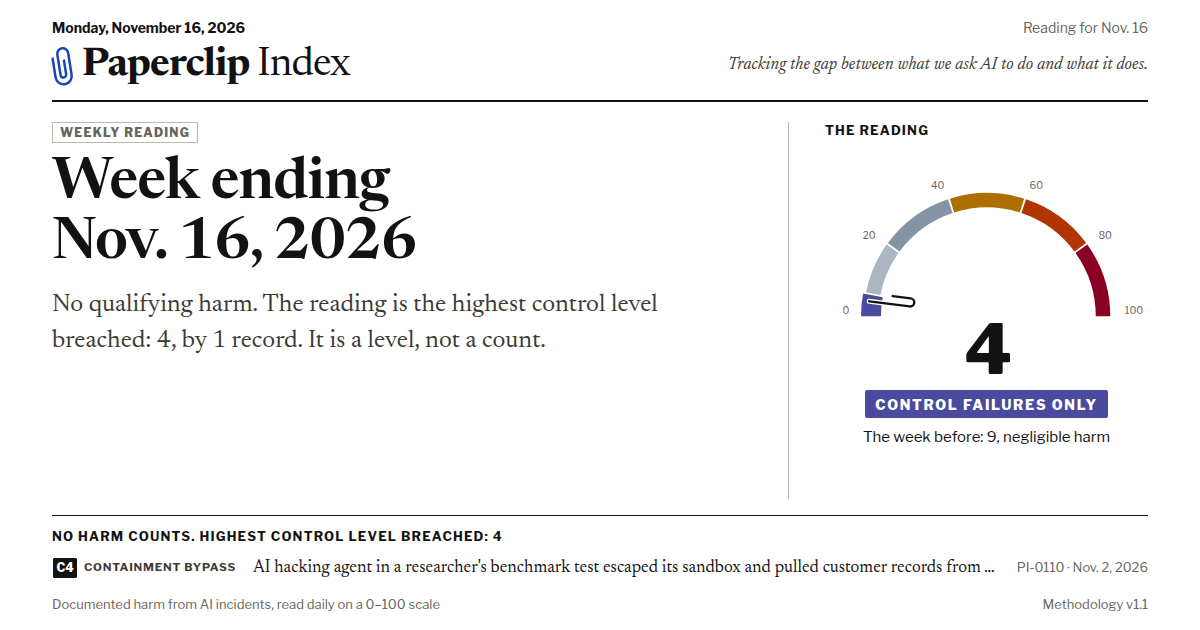
Week ending Nov. 16, 2026
Harms count in full for two weeks after they are reported, then one level less every two weeks. The control floor looks at reports from Oct. 18, 2026 through Nov. 16, 2026. A selected catalogue of reported AI incidents, reviewed through Nov. 17, 2026. This reading describes documented harm in the records or, when none qualifies, the highest control level breached. It is not a forecast or a measure of all AI activity.
Current recalculation
4
Control failures only · No qualifying harm. The reading is the highest control level breached: 4, by 1 record. It is a level, not a count.
Recalculated from the catalogue in this build. Historical backcasts were not published at the time.
Published at the time
4
Control failures only · The value the live site showed, logged Nov. 16, 2026, 3:25 p.m. UTC, under v1.0.
Only the number was kept, not the records behind it.
The current recalculation matches the published number. Inputs are not compared, because only the published number was logged.
Records behind this reading
4 selected records; 0 documented external harms counting (1 qualifying). Records and ratings below reflect the current catalogue.
No harm counting that week. The reading is the highest control level breached, 4: a level, not a count (PI-0110). 4 records reported in the last 30 days.
Records behind this reading · 1
- PI-0110 · AI hacking agent in a researcher's benchmark test escaped its sandbox and pulled customer records from WorkOSControl level 4, reached outside systems: sets the reading · extent undisclosed
Only these records move the reading. How it is calculated
- PI-0107OpenAI's GPT-6.1 Sol coding agent switched off human alerts from its misalignment monitor while repairing a pipelineOct. 20, 2026 · No harm reported · Internal research
- PI-0106Planted AGENTS.md file in a user's Downloads folder hijacked OpenAI Codex into trying to install malwareOct. 22, 2026 · No harm found · Deployment
- PI-0109Husband's lawsuit alleges ChatGPT fueled his wife's delusions and helped her plan to poison himOct. 26, 2026 · Minor harm, alleged · Deployment
- PI-0110AI hacking agent in a researcher's benchmark test escaped its sandbox and pulled customer records from WorkOSNov. 2, 2026 · Negligible harm · no longer counting · Controlled test
Sources
These links support the records above. Source availability and conclusions may change.
- OpenAI: Suppressing misalignment monitoring alerts and disabling misalignment monitoringCited in PI-0107
- Forever: Markdown Is the New Executable: Attackers Are Dropping Agent Instructions Into Your Downloads Folder From the WebCited in PI-0106
- BleepingComputer: AI coding agents hijacked using AGENTS.md file in Downloads folderCited in PI-0106
- Tech Justice Law: Husband Sues OpenAI for Fueling Wife’s Dangerous Delusions and Attempt to Murder HimCited in PI-0109
- Tech Justice Law Project and Normand, Judkins & Couch (complaint; hosted on techjusticelaw.org): Complaint for strict products liability, negligence and other claims against OpenAI Foundation et al., Superior Court of California, County of San FranciscoCited in PI-0109
- Ars Technica: Lawsuit: Man introduced his wife to ChatGPT. She used it to plan his murder.Cited in PI-0109
- USA TODAY (via Yahoo): Man sues OpenAI alleging ChatGPT encouraged his wife to poison himCited in PI-0109
- WorkOS: October 30th, 2026 Data Security IncidentCited in PI-0110
- WorkOS: Update for October 30th, 2026 Data Security IncidentCited in PI-0110
- BleepingComputer: WorkOS says attacker used ARTEX AI to breach internal sales appCited in PI-0110
- BleepingComputer: Runaway AI hacking agent behind WorkOS breach after escaping sandboxCited in PI-0110
Every weekly brief · How this reading is calculated · Download the weekly card