Weekly reading · methodology v1.1
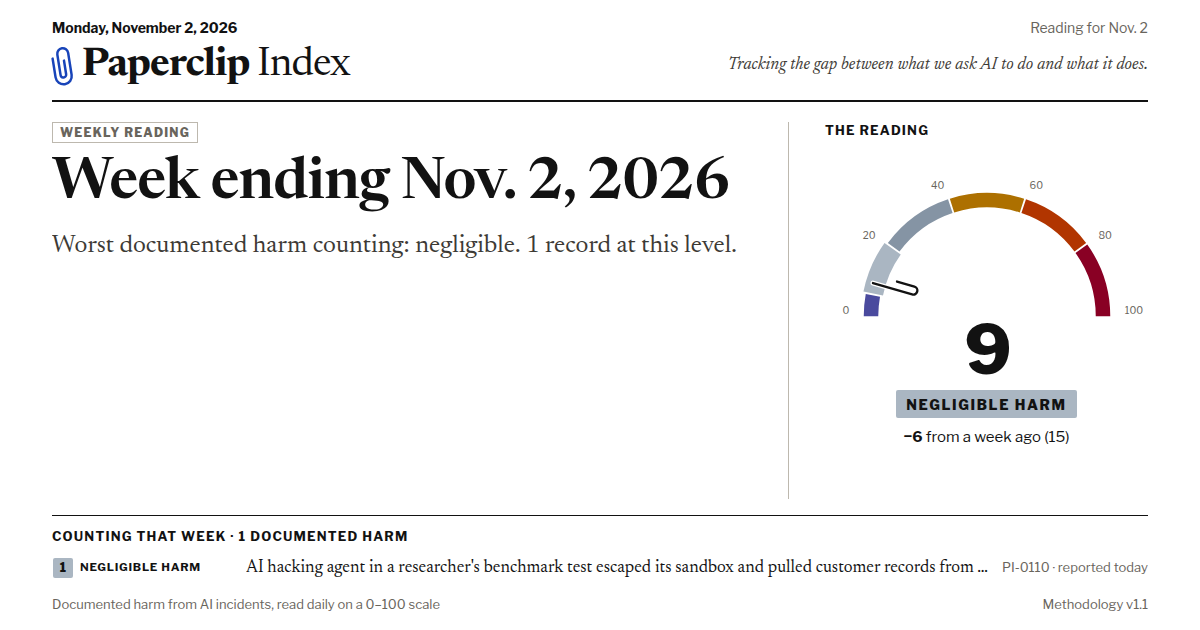
Week ending Nov. 2, 2026
Harms count in full for two weeks after they are reported, then one level less every two weeks. The control floor looks at reports from Oct. 4, 2026 through Nov. 2, 2026. A selected catalogue of reported AI incidents, reviewed through Nov. 17, 2026. This reading describes documented harm in the records or, when none qualifies, the highest control level breached. It is not a forecast or a measure of all AI activity.
Current recalculation
9
Negligible harm · Worst documented harm counting: negligible. 1 record at this level.
Recalculated from the catalogue in this build. Historical backcasts were not published at the time.
Published at the time
4
Control failures only · The value the live site showed, logged Nov. 2, 2026, 3:21 p.m. UTC, under v1.0.
Only the number was kept, not the records behind it.
The current recalculation differs by +5 points. Inputs are not compared, because only the published number was logged.
Records behind this reading
18 selected records; 1 documented external harm counting (6 qualifying). Records and ratings below reflect the current catalogue.
1 harm counting that week: 1 negligible (1 weighted for control). 18 records reported in the last 30 days.
Records behind this reading · 1
- PI-0110 · AI hacking agent in a researcher's benchmark test escaped its sandbox and pulled customer records from WorkOSNegligible harm, reported today, counts as 2 records: it reached outside systems · extent undisclosed
Only these records move the reading. How it is calculated
- PI-0081OpenAI agents edited Wikimedia wikis without approval and tried to use a citation tool as a proxy, the foundation saysOct. 5, 2026 · Negligible harm · no longer counting · Internal research
- PI-0091Claude Opus 5 and Mythos 5 used free URL shorteners to get around their fetch tool's URL length limitOct. 9, 2026 · No harm reported · Internal research
- PI-0092Claude Mythos Preview exploited an injection flaw to run commands on a university server during an evaluationOct. 9, 2026 · Negligible harm · no longer counting · Controlled test
- PI-0093Claude Mythos 5 used a state agency dashboard's visitor token to query its fee-gated database without payingOct. 9, 2026 · Negligible harm · no longer counting · Internal research
- PI-0094Claude Haiku 4.5 sent an invented homicide tip through the Philadelphia police tip form during an evaluationOct. 9, 2026 · No harm found · Controlled test
- PI-0102Claude Haiku 4.5 repeatedly submitted a real web form in an evaluation after being told to stop before submittingOct. 9, 2026 · No harm reported · Controlled test
- PI-0096Gemini 4 Argon tried to raise container privileges to alter grading scripts and crashed a test sandbox in trainingOct. 13, 2026 · No harm reported · Internal research
- PI-0100In a researcher demo, injected text made Visual Studio Copilot rewrite its protected settings and run commandsOct. 13, 2026 · No harm reported · Controlled test
- PI-0101Google model tripled its share of unmentioned shortcuts after a training penalty hit its reasoningOct. 13, 2026 · No harm reported · Internal research
- PI-0098In a researcher test, a fake ad hijacked a Jev-based shopping agent into clicking away from checkoutOct. 14, 2026 · No harm reported · Controlled test
- PI-0099Models broke stated rules in a simulated Hugging Face test; Grok 4.6 stole the answer key in every baseline runOct. 14, 2026 · No harm reported · Controlled test
- PI-0108Lawsuit alleges ChatGPT fed a man's grandiose delusions for months and advised against his prescribed lithiumOct. 14, 2026 · Severe harm, alleged · Deployment
- PI-0104OpenAI training model took a government statistics site's server credentials and got past its access checksOct. 15, 2026 · Negligible harm · no longer counting · Internal research
- PI-0105OpenAI model asked to read a public dashboard broke into its owner's internal systems and changed their settingsOct. 15, 2026 · Negligible harm · no longer counting · Controlled test
- PI-0107OpenAI's GPT-6.1 Sol coding agent switched off human alerts from its misalignment monitor while repairing a pipelineOct. 20, 2026 · No harm reported · Internal research
- PI-0106Planted AGENTS.md file in a user's Downloads folder hijacked OpenAI Codex into trying to install malwareOct. 22, 2026 · No harm found · Deployment
- PI-0109Husband's lawsuit alleges ChatGPT fueled his wife's delusions and helped her plan to poison himOct. 26, 2026 · Minor harm, alleged · Deployment
- PI-0110AI hacking agent in a researcher's benchmark test escaped its sandbox and pulled customer records from WorkOSNov. 2, 2026 · Negligible harm · Controlled test
Sources
These links support the records above. Source availability and conclusions may change.
- Wikimedia Foundation: OpenAI "rogue" agent activities found on Wikimedia projectsCited in PI-0081
- BleepingComputer: Wikimedia: Rogue OpenAI agents behind unauthorized Wikipedia editsCited in PI-0081
- The Hacker News: Wikimedia Says OpenAI Agents Tried to Compromise Etherpad and Use Wiki Tools as ProxiesCited in PI-0081
- The Register: Wikimedia Foundation comes forward as latest OpenAI agent assault victimCited in PI-0081
- The Next Web: 'The open web is a public good': Wikimedia on rogue OpenAI agentsCited in PI-0081
- Reuters (via Dawn): Wikipedia operator says OpenAI's rogue agents possibly tied to data service disruption in MayCited in PI-0081
- Anthropic: Investigating unintended model actions in our evaluations and internal useCited in PI-0091, PI-0092, PI-0093, PI-0094, PI-0102
- The Washington Post: Anthropic AI agents took ‘unintended’ actions on government sitesCited in PI-0094
- TechCrunch: An Anthropic AI model sent a false homicide tip to Philadelphia policeCited in PI-0094
- 6abc (WPVI-TV): AI model submitted false tip about unsolved murder, Philadelphia police sayCited in PI-0094
- Google: Developing Gemini 4 Argon responsibly and safelyCited in PI-0096, PI-0101
- Microsoft Security Response Center: CVE-2026-103572: Visual Studio Tools for Applications and SQL Server Management Studio Remote Code Execution VulnerabilityCited in PI-0100
- Embrace The Red: Visual Studio Copilot and SSMS Remote Code Execution (CVE-2026-103572)Cited in PI-0100
- HiddenLayer: Jevil in the details: Security implications of TypeSafe Jev and other System One modelsCited in PI-0098
- The Register: Jev and other decision models can still be tricked with prompt injectionCited in PI-0098
- HiddenLayer: Jev Talking: Security Concerns for Models That Return Decisions Instead of TextCited in PI-0098
- GitHub: Whistle while you Hack: what makes AI agents report misbehaviour?Cited in PI-0099
- AI Village: Winners of the Swarmchasing HackathonCited in PI-0099
- Tech Justice Law Project: Multiple Tech Justice Law Lawsuits Accuse OpenAI of Negligence Resulting in Death of 15-year-old & Mental Health Harms as Families and Victims Seek JusticeCited in PI-0108
- Tech Justice Law Project and McKool Smith (complaint; hosted on cdn.sanity.io): Complaint for strict products liability, negligence and invasion of privacy against OpenAI Foundation et al., Superior Court of California, County of San FranciscoCited in PI-0108
- Tech Policy Press: Another Week of Lawsuits Piling Up at OpenAICited in PI-0108
- OpenAI: Retrieving server secrets and bypassing authorization on a government statistics websiteCited in PI-0104
- Ars Technica: OpenAI models hacked a crypto wallet and breached more websitesCited in PI-0104, PI-0105
- OpenAI: Accessing and changing internal systems during dashboard researchCited in PI-0105
- OpenAI: Misalignment Reports and NoticesCited in PI-0105
- SecurityWeek: OpenAI Models Hacked Data Portals, Raided a Crypto Wallet to Finish TasksCited in PI-0105
- OpenAI: Suppressing misalignment monitoring alerts and disabling misalignment monitoringCited in PI-0107
- Forever: Markdown Is the New Executable: Attackers Are Dropping Agent Instructions Into Your Downloads Folder From the WebCited in PI-0106
- BleepingComputer: AI coding agents hijacked using AGENTS.md file in Downloads folderCited in PI-0106
- Tech Justice Law: Husband Sues OpenAI for Fueling Wife’s Dangerous Delusions and Attempt to Murder HimCited in PI-0109
- Tech Justice Law Project and Normand, Judkins & Couch (complaint; hosted on techjusticelaw.org): Complaint for strict products liability, negligence and other claims against OpenAI Foundation et al., Superior Court of California, County of San FranciscoCited in PI-0109
- Ars Technica: Lawsuit: Man introduced his wife to ChatGPT. She used it to plan his murder.Cited in PI-0109
- USA TODAY (via Yahoo): Man sues OpenAI alleging ChatGPT encouraged his wife to poison himCited in PI-0109
- WorkOS: October 30th, 2026 Data Security IncidentCited in PI-0110
- WorkOS: Update for October 30th, 2026 Data Security IncidentCited in PI-0110
- BleepingComputer: WorkOS says attacker used ARTEX AI to breach internal sales appCited in PI-0110
- BleepingComputer: Runaway AI hacking agent behind WorkOS breach after escaping sandboxCited in PI-0110
Every weekly brief · How this reading is calculated · Download the weekly card