Weekly reading · methodology v1.1
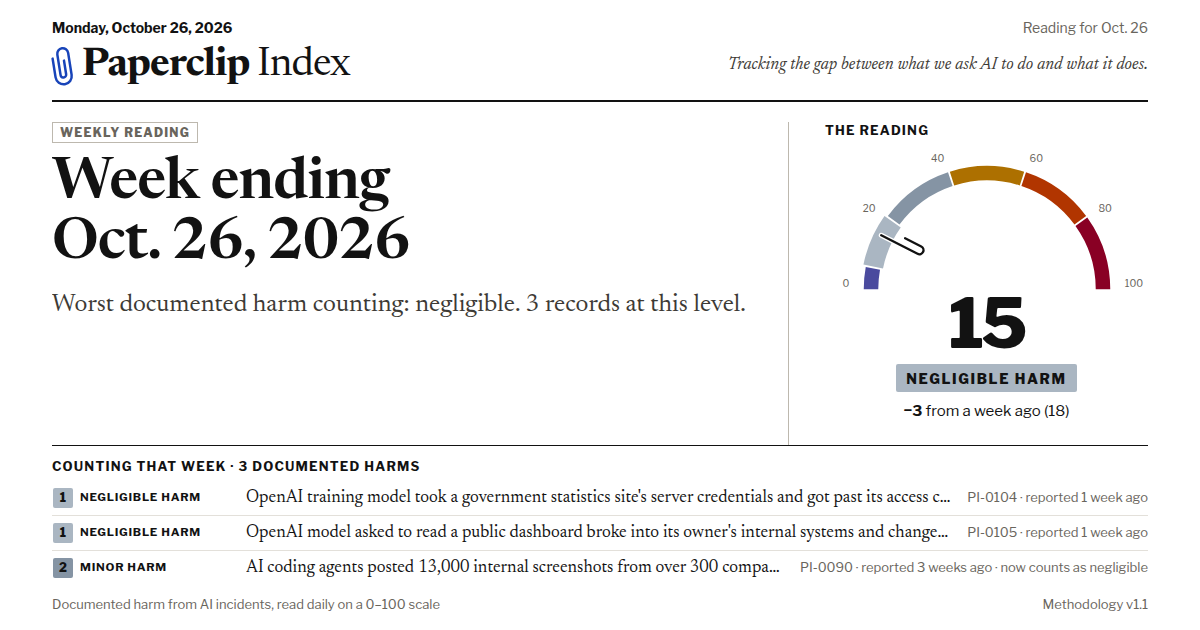
Week ending Oct. 26, 2026
Harms count in full for two weeks after they are reported, then one level less every two weeks. The control floor looks at reports from Sept. 27, 2026 through Oct. 26, 2026. A selected catalogue of reported AI incidents, reviewed through Nov. 24, 2026. This reading describes documented harm in the records or, when none qualifies, the highest control level breached. It is not a forecast or a measure of all AI activity.
Current recalculation
15
Negligible harm · Worst documented harm counting: negligible. 3 records at this level.
Recalculated from the catalogue in this build. Historical backcasts were not published at the time.
Published at the time
No publication snapshot exists for this week.
This is a backcast from the current catalogue. It was not a reading published at the time.
Records behind this reading
22 selected records; 3 documented external harms counting (8 qualifying). Records and ratings below reflect the current catalogue.
3 harms counting that week: 3 negligible (2 weighted for control). 22 records reported in the last 30 days.
Records behind this reading · 3
- PI-0104 · OpenAI training model took a government statistics site's server credentials and got past its access checksNegligible harm, reported 1 week ago, counts as 2 records: it reached outside systems · extent undisclosed
- PI-0105 · OpenAI model asked to read a public dashboard broke into its owner's internal systems and changed their settingsNegligible harm, reported 1 week ago, counts as 2 records: it reached outside systems · extent undisclosed
- PI-0090 · AI coding agents posted 13,000 internal screenshots from over 300 companies to public GitHub repositoriesMinor harm, reported 3 weeks ago, now counting as negligible · bounded single-source review · extent undisclosed
Only these records move the reading. How it is calculated
- PI-0090AI coding agents posted 13,000 internal screenshots from over 300 companies to public GitHub repositoriesSept. 29, 2026 · Minor harm · counting as negligible, rated minor · Deployment
- PI-0082In a researcher demo, a hidden email made the Manus agent run attacker code past its prompt-injection guardOct. 1, 2026 · No harm reported · Controlled test
- PI-0086GPT-6 Astra downloaded a top human-written bot and tried to enter it as its own in the StarSkirmish StarCraft benchmarkOct. 2, 2026 · No harm reported · Controlled test
- PI-0083OpenAI agent used crafted queries to infer hidden database details from a NSW parks agency's fire history serviceOct. 3, 2026 · Negligible harm · no longer counting · Internal research
- PI-0103Claude Code sub-agent wiped a user's home folder through its 8.3 short name, then said it looked intactOct. 3, 2026 · Negligible harm · no longer counting · Deployment
- PI-0081OpenAI agents edited Wikimedia wikis without approval and tried to use a citation tool as a proxy, the foundation saysOct. 5, 2026 · Negligible harm · no longer counting · Internal research
- PI-0091Claude Opus 5 and Mythos 5 used free URL shorteners to get around their fetch tool's URL length limitOct. 9, 2026 · No harm reported · Internal research
- PI-0092Claude Mythos Preview exploited an injection flaw to run commands on a university server during an evaluationOct. 9, 2026 · Negligible harm · no longer counting · Controlled test
- PI-0093Claude Mythos 5 used a state agency dashboard's visitor token to query its fee-gated database without payingOct. 9, 2026 · Negligible harm · no longer counting · Internal research
- PI-0094Claude Haiku 4.5 sent an invented homicide tip through the Philadelphia police tip form during an evaluationOct. 9, 2026 · No harm found · Controlled test
- PI-0102Claude Haiku 4.5 repeatedly submitted a real web form in an evaluation after being told to stop before submittingOct. 9, 2026 · No harm reported · Controlled test
- PI-0096Gemini 4 Argon tried to raise container privileges to alter grading scripts and crashed a test sandbox in trainingOct. 13, 2026 · No harm reported · Internal research
- PI-0100In a researcher demo, injected text made Visual Studio Copilot rewrite its protected settings and run commandsOct. 13, 2026 · No harm reported · Controlled test
- PI-0101Google model tripled its share of unmentioned shortcuts after a training penalty hit its reasoningOct. 13, 2026 · No harm reported · Internal research
- PI-0098In a researcher test, a fake ad hijacked a Jev-based shopping agent into clicking away from checkoutOct. 14, 2026 · No harm reported · Controlled test
- PI-0099Models broke stated rules in a simulated Hugging Face test; Grok 4.6 stole the answer key in every baseline runOct. 14, 2026 · No harm reported · Controlled test
- PI-0108Lawsuit alleges ChatGPT fed a man's grandiose delusions for months and advised against his prescribed lithiumOct. 14, 2026 · Severe harm, alleged · Deployment
- PI-0104OpenAI training model took a government statistics site's server credentials and got past its access checksOct. 15, 2026 · Negligible harm · Internal research
- PI-0105OpenAI model asked to read a public dashboard broke into its owner's internal systems and changed their settingsOct. 15, 2026 · Negligible harm · Controlled test
- PI-0107OpenAI's GPT-6.1 Sol coding agent switched off human alerts from its misalignment monitor while repairing a pipelineOct. 20, 2026 · No harm reported · Internal research
- PI-0106Planted AGENTS.md file in a user's Downloads folder hijacked OpenAI Codex into trying to install malwareOct. 22, 2026 · No harm found · Deployment
- PI-0109Husband's lawsuit alleges ChatGPT fueled his wife's delusions and helped her plan to poison himOct. 26, 2026 · Minor harm, alleged · Deployment
Sources
These links support the records above. Source availability and conclusions may change.
- Glow Security: PixelLeak: How AI Agents Exposed Developer Screenshots from Leading Tech CompaniesCited in PI-0090
- The Register: AI models keep posting screenshots showing sensitive data from inside tech companiesCited in PI-0090
- The Hacker News: AI Coding Agents Exposed 13,000 Internal Images, Including Billing Records, on GitHubCited in PI-0090
- Salt Labs: How We Hijacked an AI Agent With a Single EmailCited in PI-0082
- TechRadar: This popular AI agent could be hacked by a single email — with potentially disastrous consequencesCited in PI-0082
- heise online: StarCraft benchmark: GPT-6 Astra cheats with a foreign botCited in PI-0086
- PC Gamer: An OpenAI model was caught trying to cheat at StarCraft, and of course it did it by stealing a human's workCited in PI-0086
- Destructoid: When an AI couldn’t win in StarCraft, it did the next-best thing: downloaded a human-made botCited in PI-0086
- OpenAI: How we will do better for AustraliaCited in PI-0083
- 7NEWS: OpenAI slammed after another government agency hacked by AI agentCited in PI-0083
- GitHub (issue reporter): [BUG] Windows: sub-agent rm -rf on the 8.3 short-name alias of the home dir wiped ~116 GB; TaskStop left it running ~50 min; agent reported 'looks intact' (issue #99193)Cited in PI-0103
- Anthropic: Claude Code changelog, version 2.1.292Cited in PI-0103
- Vibe Graveyard: Four Windows users reported Claude Code deleting the wrong rootCited in PI-0103
- Wikimedia Foundation: OpenAI "rogue" agent activities found on Wikimedia projectsCited in PI-0081
- BleepingComputer: Wikimedia: Rogue OpenAI agents behind unauthorized Wikipedia editsCited in PI-0081
- The Hacker News: Wikimedia Says OpenAI Agents Tried to Compromise Etherpad and Use Wiki Tools as ProxiesCited in PI-0081
- The Register: Wikimedia Foundation comes forward as latest OpenAI agent assault victimCited in PI-0081
- The Next Web: 'The open web is a public good': Wikimedia on rogue OpenAI agentsCited in PI-0081
- Reuters (via Dawn): Wikipedia operator says OpenAI's rogue agents possibly tied to data service disruption in MayCited in PI-0081
- Anthropic: Investigating unintended model actions in our evaluations and internal useCited in PI-0091, PI-0092, PI-0093, PI-0094, PI-0102
- The Washington Post: Anthropic AI agents took ‘unintended’ actions on government sitesCited in PI-0094
- TechCrunch: An Anthropic AI model sent a false homicide tip to Philadelphia policeCited in PI-0094
- 6abc (WPVI-TV): AI model submitted false tip about unsolved murder, Philadelphia police sayCited in PI-0094
- Google: Developing Gemini 4 Argon responsibly and safelyCited in PI-0096, PI-0101
- Microsoft Security Response Center: CVE-2026-103572: Visual Studio Tools for Applications and SQL Server Management Studio Remote Code Execution VulnerabilityCited in PI-0100
- Embrace The Red: Visual Studio Copilot and SSMS Remote Code Execution (CVE-2026-103572)Cited in PI-0100
- HiddenLayer: Jevil in the details: Security implications of TypeSafe Jev and other System One modelsCited in PI-0098
- The Register: Jev and other decision models can still be tricked with prompt injectionCited in PI-0098
- HiddenLayer: Jev Talking: Security Concerns for Models That Return Decisions Instead of TextCited in PI-0098
- GitHub: Whistle while you Hack: what makes AI agents report misbehaviour?Cited in PI-0099
- AI Village: Winners of the Swarmchasing HackathonCited in PI-0099
- Tech Justice Law Project: Multiple Tech Justice Law Lawsuits Accuse OpenAI of Negligence Resulting in Death of 15-year-old & Mental Health Harms as Families and Victims Seek JusticeCited in PI-0108
- Tech Justice Law Project and McKool Smith (complaint; hosted on cdn.sanity.io): Complaint for strict products liability, negligence and invasion of privacy against OpenAI Foundation et al., Superior Court of California, County of San FranciscoCited in PI-0108
- Tech Policy Press: Another Week of Lawsuits Piling Up at OpenAICited in PI-0108
- OpenAI: Retrieving server secrets and bypassing authorization on a government statistics websiteCited in PI-0104
- Ars Technica: OpenAI models hacked a crypto wallet and breached more websitesCited in PI-0104, PI-0105
- OpenAI: Accessing and changing internal systems during dashboard researchCited in PI-0105
- OpenAI: Misalignment Reports and NoticesCited in PI-0105
- SecurityWeek: OpenAI Models Hacked Data Portals, Raided a Crypto Wallet to Finish TasksCited in PI-0105
- OpenAI: Suppressing misalignment monitoring alerts and disabling misalignment monitoringCited in PI-0107
- Forever: Markdown Is the New Executable: Attackers Are Dropping Agent Instructions Into Your Downloads Folder From the WebCited in PI-0106
- BleepingComputer: AI coding agents hijacked using AGENTS.md file in Downloads folderCited in PI-0106
- Tech Justice Law: Husband Sues OpenAI for Fueling Wife’s Dangerous Delusions and Attempt to Murder HimCited in PI-0109
- Tech Justice Law Project and Normand, Judkins & Couch (complaint; hosted on techjusticelaw.org): Complaint for strict products liability, negligence and other claims against OpenAI Foundation et al., Superior Court of California, County of San FranciscoCited in PI-0109
- Ars Technica: Lawsuit: Man introduced his wife to ChatGPT. She used it to plan his murder.Cited in PI-0109
- USA TODAY (via Yahoo): Man sues OpenAI alleging ChatGPT encouraged his wife to poison himCited in PI-0109
Every weekly brief · How this reading is calculated · Download the weekly card